Who’s On Fifth?
- Ask the DOC
Rockaway Stuff
- 0
- 3 minutes read

By Peter Galvin, MD
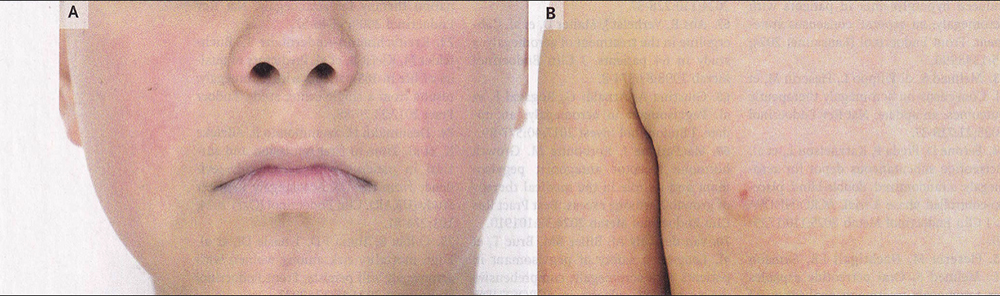
A previously healthy 8-year-old boy was brought to the dermatology clinic with a seven-day history of an itchy rash on his cheeks and a lacy rash on his chest and arms. He reported no recent fever, runny nose, or malaise. On physical examination, there was a flat, red rash on both cheeks that spared the perioral region (Panel A) and a reticular (lacy) rash on the trunk and arms (Panel B). A complete blood count was normal. A diagnosis of erythema infectiosum – aka fifth disease – was made.
Erythema infectiosum is a viral exanthem (rash) caused by parvovirus B19, which contains a single strand of DNA. It may involve a viral prodrome (illness) before the appearance of the rash. As the viremia (virus in the bloodstream) resolves, the rash appears as a “slapped cheek” pattern on the face and progresses to a lacy rash on the trunk and arms. After the rash disappears, it may reappear in response to certain triggers, for example sunlight. Usually, a diagnosis of erythema infectiosum can be made clinically, although a blood test may be helpful to confirm it in some cases.
Usually, erythema infectiosum affects children between the ages of 5 to 15 years. Outbreaks are often seen in day care centers and schools. Rarely, it can be seen in adults, especially those who are pregnant or have a compromised immune system. Adult disease may include severe joint pain. Parvovirus B19 was discovered in 1975, and erythema infectiosum is the only known human disease caused by it. Fever and pain are rarely seen with childhood erythema infectiosum, and, if present, should be treated with acetaminophen. Aspirin should never be used to treat childhood fever because of the risk of Reyes syndrome, a potentially fatal complication.
Ironically, erythema infectiosum is also known as fifth disease. When first discovered, erythema infectiosum was indeed the fifth known disease to cause a rash in children, thus its nickname. However, today there are six such diseases which are, in decreasing order of worldwide cases are: 1) measles; 2) scarlet fever; 3) rubella; 4) erythema infectiosum; 5) Duke’s disease, also known as Staphylococcal Scalded Skin Syndrome, or SSSS; and 6) roseola, aka sixth disease. So, you see, fifth disease is actually “fourth disease” today. There is no vaccine for erythema infectiosum.
The patient and his family in this case were reassured that the disease was self-limited, and no treatment was necessary, and a week later the rash had abated.
Please direct questions or comments to editor@rockawaytimes.com