Perpetual Union: America’s First Constitution
- NEWS
Rockaway Stuff
- 0
- 6 minutes read
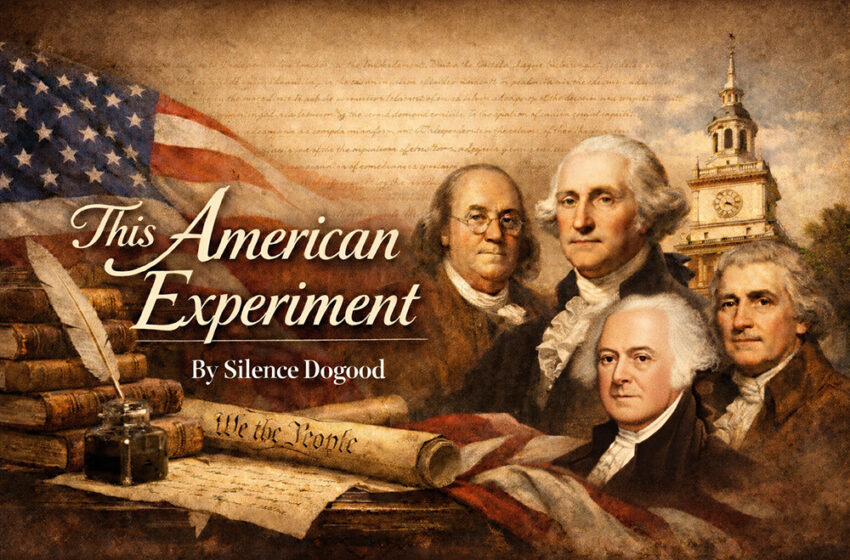
By Silence Dogood
With the arrival of 2026, we begin preparing to mark the 250th anniversary—our Semiquincentennial—of the Declaration of Independence and the founding of the United States of America: the beginning of this American experiment. What better way to observe the occasion than by looking back at some of the moments that helped shape the nation into the shining city on a hill it strives to be?
While many outlets will understandably focus on the “big” moments of American history, this column will instead turn its attention to the lesser-known—but no less important—stories. These are the stories that rarely receive the spotlight they deserve, yet played an outsized role in shaping the country we know today.
This past fall, Netflix released “Death by Lightning,” a four-part series based on Candice Millard’s excellent book “Destiny of the Republic.” Both works follow James Garfield, the 20th president of the United States—his unlikely rise to office, his equally unlikely vice president, Chester Arthur, and his eventual assassin, Charles Guiteau. The series captivated audiences not only because it was a superbly entertaining show, but because it reintroduced Americans to deeply consequential figures who, until recently, had largely been relegated to footnotes and trivia questions.
These are the kinds of stories I hope to tell. These are the people I hope to bring back to the forefront of our collective memory here in Rockaway. Because in the end, it is often these overlooked lives and forgotten moments that have quietly guided this American experiment for the past 250 years.
It is July 1776. The 13 American colonies have just declared their independence from Great Britain with the adoption of the Declaration of Independence. Now what?
It would not be until 1789—almost a full 13 years later—that the United States Constitution would be ratified. So how exactly did the country function during that time?
Almost immediately after independence was proposed by Richard Henry Lee of Virginia in June 1776, the Second Continental Congress—meeting in Philadelphia—created three committees. The most famous of these committees would go on to draft the Declaration of Independence itself. Another committee, however, was tasked with something just as consequential: creating a framework of government for this new, fledgling republic.
That committee consisted of 13 members—one from each colony—charged with drafting a constitution for the new union. The document they produced would become the first constitution of the United States—the one that actually named the country the United States of America. It was called the Articles of Confederation and Perpetual Union.
The idea behind this framework was not entirely new. It dated back to 1754, at the Albany Congress—an earlier gathering of colonial representatives—where Benjamin Franklin proposed that the 13 colonies form a unified body. Franklin’s plan was not intended to sever ties with the British Crown, but rather to promote cooperation and collective defense among the colonies. The proposal was rejected at the time, but it would later serve as the intellectual foundation for the Articles of Confederation more than two decades later.
After debate within Congress, the Articles were approved and sent to the newly independent states for ratification. Virginia became the first to ratify in 1777. It would take four more years before Maryland became the final state to ratify in 1781. With that act, the Articles of Confederation officially became the first governing document of the United States.
The Articles of Confederation and Perpetual Union were an extraordinary achievement. They did exactly what they were originally designed to do: they created a government capable of uniting 13 sovereign states.
With a king’s heavy yoke being one of the precipitating factors for the Revolution, Congress was understandably wary of making a central government too powerful. Under this new structure, each state would remain the master of its own destiny. States would have their own constitutions and their own forms of government. The federal government was meant to be a loose framework binding them together.
The new federal government consisted of just a one-house legislature called the Congress of the Confederation. There was no federal judiciary, and there was certainly no single executive—they were not about to trade one king for another of their own making.
Congress did possess several important powers: the power to declare war, negotiate treaties, coin money, and more. But more importantly, it lacked several critical elements that many Americans would soon come to see as necessary for a functional national government.
For starters, Congress could not levy taxes. While this may have seemed appropriate in the aftermath of a revolution sparked by unjust taxation, it left the federal government chronically short of funds—especially after an expensive war for independence. Congress was also unable to compel states to abide by national laws. The states remained fully sovereign. Finally, amending the Articles required unanimous consent from all 13 states—13 very different states that were often at odds with one another. Meaningful reform was nearly impossible.
Not long after ratification, those in government began to openly discuss the need for change. This culminated in a meeting in Maryland known to history as the Annapolis Convention of 1786. Although all 13 states were invited to send commissioners, only five did: New York, Pennsylvania, Virginia, New Jersey, and Delaware. Among those present were Alexander Hamilton of New York and James Madison of Virginia—two men who would go on to become principal architects and defenders of the United States Constitution.
Because of the low turnout, the Annapolis Convention itself had little immediate impact. It did, however, succeed in sending a petition to the Confederation Congress and the states proposing another convention the following year in Philadelphia. The Constitutional Convention of 1787 produced the Constitution that has governed the United States for the past 237 years, with 27 amendments added along the way.
From 1776 until 1789, the new United States was still trying to find its footing in the world. During those 13 years, some of the most inspired political minds in history debated what a government of, by, and for the people should look like.
Though the Articles of Confederation did not endure, they deserve recognition as a foundational document of the United States. For the first time in modernity, a people attempted to design their own government from scratch. Given the events that surrounded the Founders, it is hardly surprising that their first attempt erred on the side of caution.
What is most remarkable is that the union did not collapse in the face of adversity. Instead, it adapted. Competing visions—each argued by intellectual giants—were debated, challenged, and ultimately reconciled through compromise. The resulting government was stronger, but not unchecked. Powers not enumerated in the new Constitution were reserved to the states, and the Bill of Rights placed firm limits on federal authority.
The Articles of Confederation may not have been perpetual, but the union they created proved to be.