Rockaway Becomes Acquainted With Captain Singh of the 100th Precinct
- NEWS
Rockaway Stuff
- 0
- 11 minutes read
By Katie McFadden
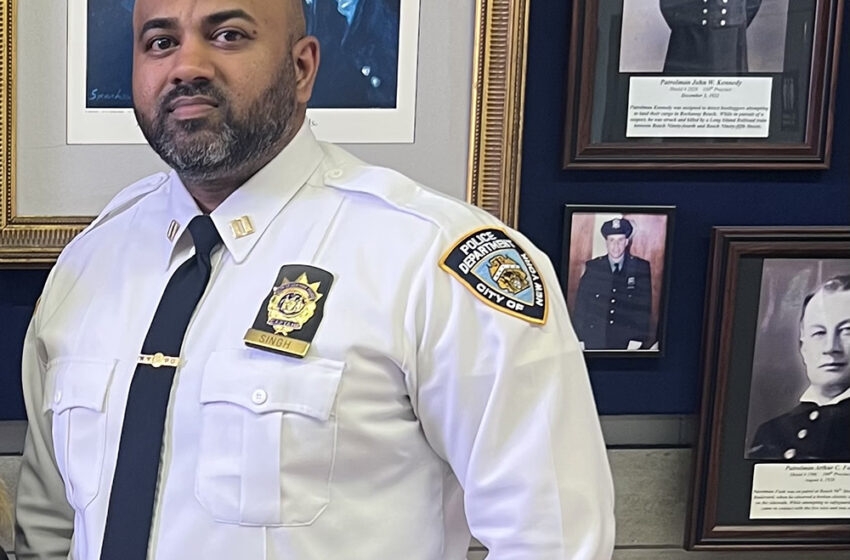
Ever since Captain Sachi Singh officially became the 100th Precinct’s commanding officer in January, he’s been hitting the ground running, getting to know some of the key players in the community, utilizing data to cater the precinct’s approach to local crime and making communication a key component of the ins and outs of the precinct to best serve the community.
Singh may be a little new to the 100th Precinct, having taken over as acting commanding officer since Deputy Inspector Carol Hamilton moved on in December, but he’s no stranger to Rockaway. Growing up and living in Ozone Park for 30 years, Rockaway was a go to spot in the summer. “I had been to this beach for more than 15 years, probably 75 times, traveling down Cross Bay to visit the beach for a few hours and head home. That was a typical summer day,” he said.
Far Rockaway was a newer experience that he got better acquainted with when he was assigned to the 101st Precinct as executive officer in 2024, an assignment that lasted about 14 months, giving him plenty of time to become familiar with the eastern end of the peninsula. Working a night shift, Singh was sometimes tasked with covering the 100th Precinct as well, making it an easy transition when Hamilton moved on and Singh took over. And after seeing what he did in just a few weeks, when it came down to a community vote among 100th Precinct Community Council members and other local leaders, they knew Singh would be a good fit as the precinct’s commanding officer. With the approval of NYPD Commissioner Jessica Tisch, it was made official on January 6, 2026.
Those who voted for him knew Rockaway would be in good hands with someone who brought more than 16 years of experience with the NYPD, officially starting in 2010, another two as a cadet before that, and even some time with the auxiliary in 2007. But in those early years, Singh didn’t have a strong interest in becoming a cop. “I was working at Autozone and going to City College of New York for the engineering program. I saw a table set up in the lobby one day, and the cop there said they paid cadets above minimum wage. I didn’t want to keep working at Autozone for minimum wage, so I signed up and went to the cadet academy for about a month and got assigned to the 113th Precinct,” Singh said. “I still didn’t want to become a cop, but with my experience at the 113 police detective unit, at that age, I saw a lot of cool things that interested me in this job, whether it was investigation, going out in the field, taking pictures, following up with victims and seeing the change that you can really affect in the community was something I liked. When I was transferred to the Office of Management and Planning (OMAP), I said, let me take the test and see how it goes. After I became a cop, I loved it. It’s a very good job. It’s rewarding. Most jobs, you don’t get to meet a variety of people. As a police officer, you get to meet a variety of people in a variety of situations.”
And those opportunities grew as Singh made his way up the ranks. Singh graduated from the NYPD academy in December 2010, and was assigned to the 79th Precinct in Bed Stuy on a patrol post for three years, which he said was “probably the best part of the job so far for me. I got to meet community members and was pretty close to the cops I was working with because we were all on foot together.” In November 2013, he was transferred to the 7th Precinct in Manhattan, working patrol on the evening shift for about two years. During that time, he passed the sergeant’s exam and was promoted in December 2015, which came with a transfer to the 67th Precinct in East Flatbush. He worked patrol there for a year, the Domestic Violence Unit for another year, as a Field Training Unit Supervisor for a year, and then the commanding officer moved him to an administrative position, where he worked for three years and got to understand the inner workings of a precinct as Administrative Sergeant. While in the 67th Precinct, he passed the Lieutenant exam, was promoted in June 2022, and transferred to the 104th Precinct around Ridgewood, where he worked for two years before being promoted to captain in June 2024 and being assigned to the 103rd Precinct in Jamaica for four months before becoming executive officer at the 101st Precinct and now commanding officer of the 100th. “I’m very happy about it and it’s a privilege to be here,” Captain Singh said.
As he moved his way up from cadet to captain, Singh took everything he learned along the way to apply it to his career, including obtaining a bachelor’s degree in international crime and justice from John Jay as a cadet. During that time, he developed an interest in data and research, which led to him working on a master’s degree in applied data science with a certification in technology in leadership. “I was very interested in data research and how to use data on the job to help us work smarter, but not harder. That’s how I make my decisions, all based on the data and how to accomplish things efficiently,” Captain Singh said.
Captain Singh’s data focus has been noticeable as he introduces himself around the peninsula, attending Community Board 14 and 100th Precinct Community Council meetings, and providing a detailed 28-day breakdown of major crimes within the precinct and highlighting concerns based on data received through 911 and 311 calls. When he first got to the precinct in December, Captain Singh noticed a 111% increase in car break-ins, many taking place late at night. So, he put a focus on it. “I adjusted my deployment during the midnight shift. The officers were taking mealtimes around 11 p.m. to 4 a.m., so I shifted mealtimes a bit, giving them later meals, which they’re happy about, and I was able to have two police cars patrolling the neighborhood instead of one,” he said. That increased presence alone may have led to a notable difference in break-ins. “Last week, we had no car break-ins through the entire peninsula,” Singh said. “For the 28-day period from January 19 to February 15, we’re down 62% from eight to two break-ins.
Going forward, he hopes to break data down even further by neighborhood, instead of general stats for the precinct, which may be vastly different between neighborhoods. “Let’s say you live in Arverne, and your neighborhood is doing well in crime. That’s not going to matter when the overall crime is read for the entire precinct. If you live in Breezy Point, I want to bring those stats to you,” he said. “So going forward, we’re going to have the 28-day crime stats broken down by sector, so we’re going to have stats on the seven major crimes, and then things that affect each neighborhood more, like on the western part of Rockaway, package theft, things being stolen from porches and car break-ins are something that affect the area more than the seven majors.”
And with that breakdown of the data by sector, as he makes his rounds to various civic meetings, including a recent town hall with the Belle Harbor Property Owners Association and others on February 11, Captain Singh has been urging the community to participate in the data collection by actively calling 911 or reporting quality of life issues to 311, so reports can be taken and there can be a clearer picture of what crimes impact certain areas. “My message at these meetings is call 911 as soon as you can, and for quality-of-life issues like double parked cars, abandoned vehicles, loud music, drinking on the beach, things that affect daily life, call 311, use the app available on phones or send a text message. We want to get cops there right away. Even if we get there and the violation is gone, at least we know it’s recurring and the next week, we can deploy much smarter and efficiently to catch the violation in progress,” Captain Singh said.
Listening to complaints at recent meetings, Captain Singh also plans to put more focus on areas of concern during the beach season. “I plan on getting four officers bike trained and four scooter trained, so you’re gonna see them at Beach 116th, 129th and 108th Street and along Shore Front. If you’re walking down the street and see a police car drive by, you’re gonna think twice about stopping them, but if you see a cop on a bike or scooter, you might get them to stop and talk and that will go a long way,” he said.
Communication is the main driving force behind Captain Singh’s goals as commanding officer. “I enjoy policing because I’m able to talk to people and communicate. Communication is three parts—speaking, listening and understanding. Most like to speak, people listen 50% and understand 25%. My cops and staff, I speak to them at roll call and hopefully they understand it. I ask for feedback and that’s how I get to see if people understand. When responding to crimes in progress or to 311 calls, they use the same communication framework to give you the best possible outcome,” Singh said, which is why he hopes the community also engages in regular communication. “What happens a lot is a community member will see an officer walk by and will report some violation that occurred two weeks ago, and they want a remedy. I want that communication to be better. I want people to be comfortable sharing a concern that might seem little to them. Your package might be stolen today, next week a neighbor might have a bike stolen, the next week there might be a car break-in. Maybe your phone call for that stolen package could prevent that bike from being stolen or that car from been broken into, because we have more patrols in the area based on past calls.”
Since spending more than a year working on the peninsula, Captain Singh has noticed some unique trends when it comes to who is committing crimes. “More than 50% of offenders are the same offenders that commit a crime, and they usually live on the peninsula. We’re seeing the same faces, the same vehicles and since the two main ways off the peninsula are the bridges, they have license plate readers, which helps us look for someone,” he said. The exception seems to be Broad Channel, which sees more activity from people not from the area. “Last week, we had two incidents where people were trespassing and both times cops responded quickly and were able to find the individuals. They both had no prior arrests. Maybe they did a bit of drinking and got on the train and wound up getting off at Broad Channel. They lived nowhere close to the 100th precinct, maybe 30 minutes away, so they’re not the usual recidivists.”
Captain Singh will continue to meet with community leaders as he becomes familiar with the unique challenges for different parts of the neighborhood. He’ll likely be with the 100th Precinct for the next two and a half years, and so far, so good. “It’s been very good. Residents are receptive and it’s been a good experience seeing the community engagement,” he said. He just reminds everyone to keep making those 911 and 311 calls so the community can help the officers of the 100th Precinct do their best.
Captain Singh will be at the next 100th Precinct Community Council meeting on Wednesday, February 25 at 7 p.m. at the Knights of Columbus. Giving recognition to his officers, he’ll be presenting several awards, and he hopes to see more of the community become active participants in such meetings.