See?
- Ask the DOC
Rockaway Stuff
- 0
- 3 minutes read

By Peter Galvin, MD
Progressive clouding of the natural lens of the eye is called a cataract. Worldwide, cataracts were responsible for about 15 million cases of blindness and 79 million cases of moderate to severe visual impairment among adults aged 50 years and older in 2020. In the U.S., the number of people with cataracts is expected to increase to 50 million by 2050. Older age is the main risk factor for cataracts, which are present in about two-thirds of people older than 80 years. Other risk factors include genetic predisposition, eye injury, high levels of sun exposure or radiation therapy to the eye, prolonged use of topical or injected steroids, and certain medical conditions such as uncontrolled diabetes, Down syndrome, and congenital rubella.
Those with cataracts experience progressively blurred vision, making it difficult to see details at a distance (such as highway signs) and close up (such as fine print). Cataracts can also increase glare from oncoming headlights and streetlights or sunlight and can make it difficult to read in conditions of low light. Ophthalmologists and optometrists diagnose cataracts by dilating the patient’s eye with eye drops and examining the eye using a slit lamp, which is a microscope with a bright light attached to illuminate the structures in the eye.
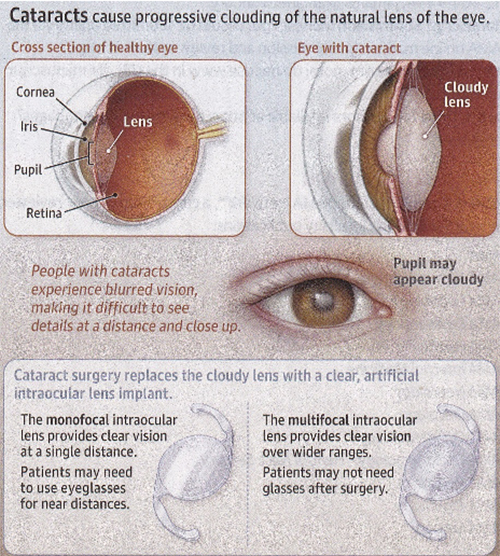
Early on, cataracts can be managed by having the correct prescription for eyeglasses and/or contact lenses and using brighter lights in dimly lit situations. Once cataracts interfere with daily life, patients should consider surgery to replace the clouded lens of the eye with a clear artificial interocular lens implant. Pre-operative medical screening is generally not required for cataract surgery, and most medications the patient is on can be continued up to and after the procedure. However, certain prostate medications such as tamsulosin can interfere with proper dilation of the eye, so a patient on these medications should make sure that the eye surgeon is aware of this to help prevent complications during surgery.
Cataract surgery is an outpatient procedure that typically required anesthetic drops to numb the eye. After a cataract is removed via a small incision, an intraocular lens is inserted. Those with cataracts in both eyes will typically undergo surgery one eye at a time within a few weeks of each other. A monofocal lens implanted during cataract surgery provides clear vision at a single distance (typically far), and these patients will use glasses to see clearly at near distances (i.e., reading). Implantation of a multifocal lens will enable the patient to see clearly over wider ranges, reducing or eliminating the need for glasses, however not all insurances cover multifocal lenses, so the patient who prefers not to need glasses after surgery may incur an out-of-pocket charge.
Post-operatively, cataract surgery patients will use eye drop medications for several weeks and will have minimal restrictions on physical activities. Complications such as eye infection or inflammation are rare, and vision usually improves within the first week after surgery. Patients who undergo cataract surgery have lower rates of falls and dementia compared with those with poor vision due to untreated cataracts.
For more information go to the website of the American Academy of Ophthalmology at www.aao.org
Please direct questions or comments to editor@rockawaytimes.com