The Revolution of 1800
- NEWS
Rockaway Stuff
- 0
- 6 minutes read
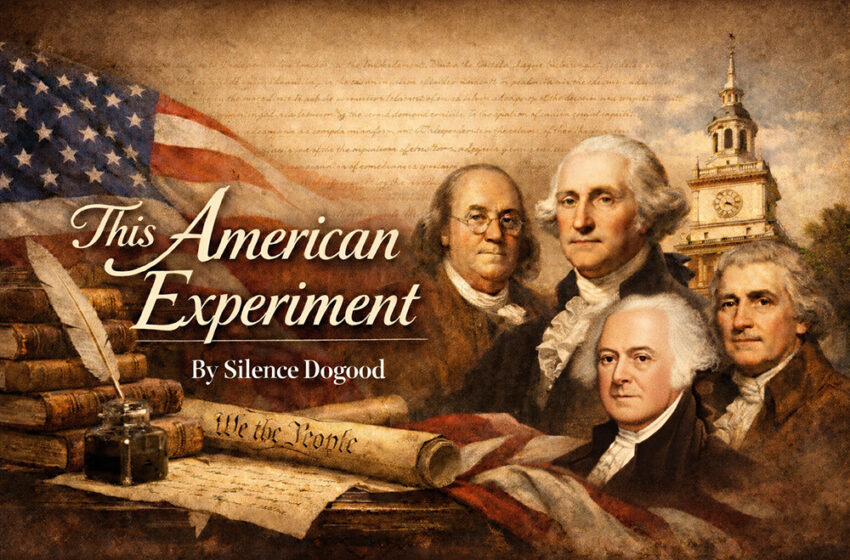
By Silence Dogood
In 1799, George Washington died. The undisputed father of the country, who had given so much to the cause of this American experiment, passed away at his home in Mount Vernon.
Three years earlier, Washington had shocked the world by following in the footsteps of the Roman hero Cincinnatus, willingly relinquishing his power and choosing not to run for a third term. (It would not be until 1951, with the passage of the 22nd Amendment, that presidential term limits would be formally established.) This act led to the first truly contested election in United States history.
In the election of 1796, John Adams, Washington’s vice president for two terms and a fellow member of the newly formed Federalist Party (not to be confused with the Federalists of last week’s article—confusing, I know), narrowly defeated Thomas Jefferson, a member of the opposition party: the Democratic-Republicans.
According to the Constitution, the winner of the election would become president, but oddly enough, the person who received the second-most votes would become vice president. This meant that Adams and Jefferson—friends, no doubt, yet unquestionably political opponents—would serve together in the same administration.
Fast forward four years to the election of 1800 and, on paper, you are faced with a rematch—this time between the sitting president and the sitting vice president. But that is just the tip of the oddity iceberg that the election of 1800 would turn out to be.
The previous four years had been sailed on stormy seas. Adams was faced with perhaps the most daunting task ever thrust upon a United States president: he had to follow George Washington. And due to several factors we do not have time to explore today, his popularity—and that of the Federalist Party in general—had faded among the American people.
Thomas Jefferson, though serving as number two in the Adams administration, remained the unquestioned leader of the opposition. From Jefferson and his party, there was no pity for John Adams. The Democratic-Republicans relished the struggles of the Adams administration and saw their opportunity to finally ascend to the highest office in 1800.
But that was not the only direction from which slings and arrows were flying at John Adams. Within his own party was a man who, though he possessed a fiery aversion to and distrust of Jefferson and the Democratic-Republicans, was also deeply discontented with how Adams was leading the Federalists. That man was Alexander Hamilton.
Hamilton and Adams had rarely seen eye to eye. Over the previous twelve years, the two Federalists had often clashed on foreign and domestic policy, as well as over the overall direction of their party.
1800 would be the first year the two parties ran organized tickets. As mentioned earlier, elections at the time did not distinguish between votes for president and vice president. Electors simply selected two candidates, and the first- and second-place vote-getters would assume their respective positions.
The Federalist ticket was headed by President John Adams, with Charles Cotesworth Pinckney of South Carolina as his running mate. The Democratic-Republican ticket consisted of Thomas Jefferson and Aaron Burr of New York.
The election of 1800 was bitter. Democratic-Republicans portrayed Adams as a monarchist eager to cozy up to Great Britain after having sided against France during the turmoil of the French Revolution. Federalists, meanwhile, painted Jefferson as an atheist and political radical who would destroy the new republic. Newspapers across the country were filled with mudslinging from both sides.
In a stunning move, in October 1800, Alexander Hamilton went so far as to actively campaign against John Adams—the candidate of his own party—by releasing a pamphlet titled “Letter from Alexander Hamilton, Concerning the Public Conduct and Character of John Adams, Esq., President of the United States.” This internal attack on Adams was a foreboding omen of things to come in the national race.
Partly because of internal division within the Federalist Party and partly because of public dissatisfaction with laws such as the Alien and Sedition Acts, Adams faced a steep uphill battle. When the dust settled, he finished in third place with 65 electoral votes, while Pinckney followed closely behind with 64.
Just as the Democratic-Republicans had hoped, Jefferson and Burr emerged victorious. But there was a catch: both men received 73 electoral votes. Because there was no distinction between votes for president and vice president, the result was a tie.
According to the Constitution, in such an event, the decision would be thrown to the House of Representatives, where each state delegation would cast a single vote for either man. To further complicate matters, the current lame-duck House was controlled by the Federalist Party.
Democratic-Republicans feared the Federalists might use the crisis to delay or overturn the election. Rumors swirled that New York Governor and former Chief Justice John Jay or Secretary of State John Marshall—both Federalists—could somehow ascend to the office. Tensions across the country ran high.
Curiously, Burr—the running mate, not the top of the ticket—did little to remedy the problem by publicly conceding to Jefferson. After all, this was an opportunity to become President of the United States.
When voting finally began in the House in early February 1801, the result was deadlocked. Ballot after ballot produced no decision. With the March 4 inauguration date approaching, Americans began to wonder what would happen if the matter was not settled in time.
After 35 ballots in the House, Jefferson prevailed on the 36th. The final tally was 10 states for Jefferson, four for Burr, with two abstaining. On February 17, 1801, Thomas Jefferson became the third president-elect of the United States of America.
In 1804, the Twelfth Amendment to the United States Constitution was ratified. It required electors to cast separate votes for president and vice president, eliminating the flaw that had nearly thrown the young republic into chaos. Even with this change, just a couple of decades later, the election of 1824 would again be decided in the House of Representatives—this time placing a different Adams in the White House.
The election of 1800 was a pivotal moment in the early life of the republic. The Constitution had been revealed to be imperfect. Yet more importantly, it demonstrated that a flaw in the system could be confronted and eventually corrected, all within the boundaries of that very system.
It was also the first time there had been a peaceful, albeit tempestuous, transfer of power between opposing political parties. In 1800, this was not merely unusual—it was extraordinary. In Europe at the time, political power was rarely surrendered voluntarily and almost never without bloodshed.
The outcome of 1800 sent a message that the system the Framers had built could work. What’s more, it was a statement to the entire world that this American experiment was not a fragile novelty. It was durable. It could withstand ambition, rivalry, and even crisis—and endure.