Richard Mott House Officially Registered as Historic
- NEWS
Rockaway Stuff
- 0
- 14 minutes read
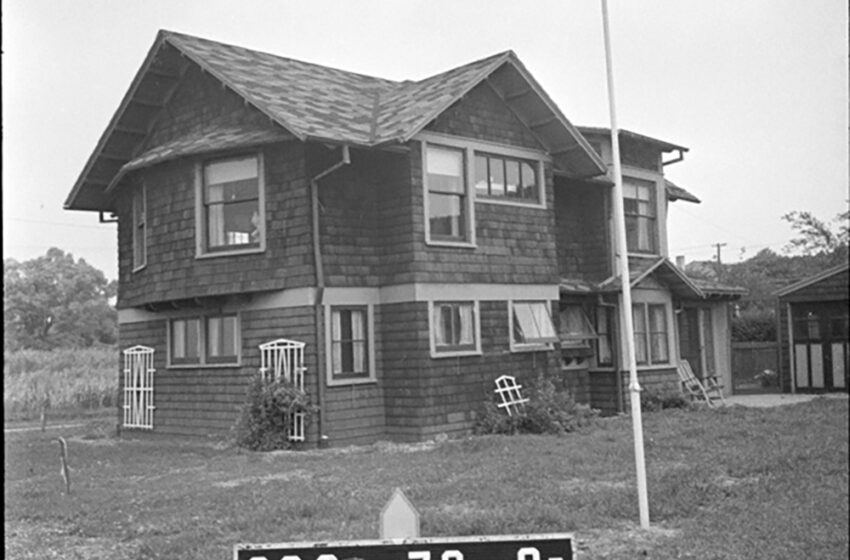
Richard Mott House in 1940.
By Katie McFadden
At the turn of the turn of the 20th century, Richard Mott, an artist and builder, was putting the finishing touches on a unique wooden, shingle-style home at 1272 Norton Drive in Bayswater. At the time, around the early 1900s, Mott built the home as an artist studio, a place to escape his primary residence and day job and draw inspiration from the bayside scenery outside his windows to paint. And near the turn of the 21st century, the unique, historic home found itself in the hands of another artist and craftsman, Patrick Clark, and it became the place he lays his head after a day of hard work at his stained-glass studio in Rockaway Beach. But after restoring and maintaining much of the historic aspects of the Richard Mott home over nearly 30 years, Clark’s efforts to preserve it have officially earned his home a spot on the New York State Register of Historic Places and has been nominated for the National Register.
Take a drive down Norton Drive in Bayswater and you’ll come across a home that doesn’t look like any other still around. That’s because it embraces the shingle style made popular in the 1880s and early 1900s, especially around the area. From roof to foundation, the home’s exterior is covered in wood shingles, a style that phased out with renovations and demolitions over the last century in the surrounding area. The preservation of that style was one of the criteria needed to apply for it to be nominated for the New York State Register of Historic Places.
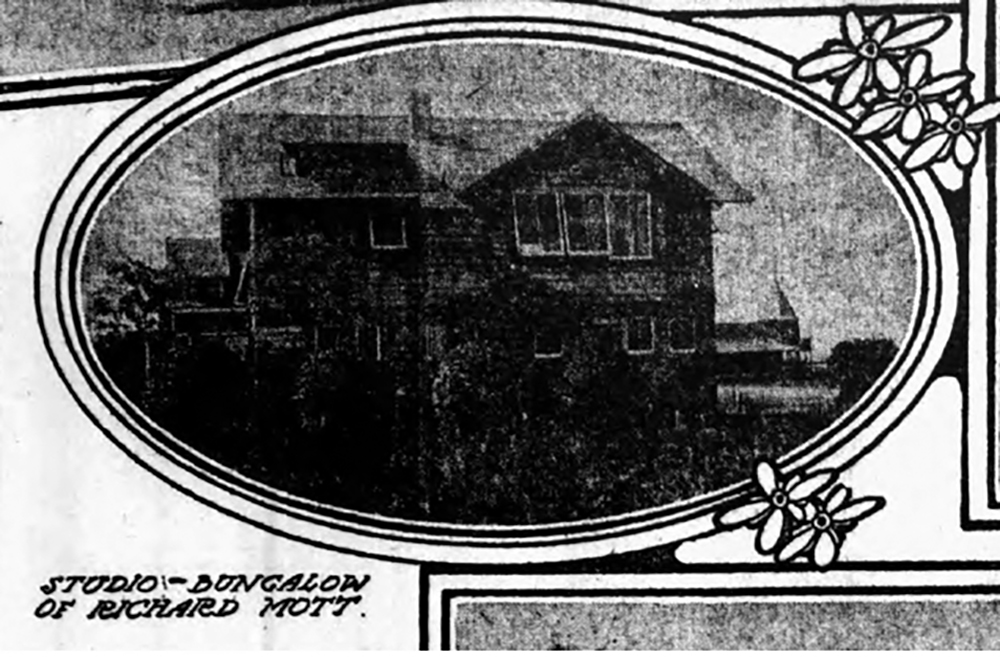
But the home itself holds more than a century of history, telling its own story. It is believed Richard Mott built the original structure as a barn or outbuilding near his family home in 1880 and by 1909, he was finishing refashioning it into a two-story bayside cottage to be used as his art studio. And he did it all himself. A 1909 article in the New York Herald noted, “he has allowed no one else to drive so much as a nail in the structure.”

One branch of the wealthy and influential Mott family in Bayswater, Richard Mott and his wife, Louisa, owned and ran Greyloch Hall, a notable hotel and boarding house, just a few blocks away. It is believed Greyloch Hall served as the primary residence for Richard and his wife, but he used the home on Norton Drive as his personal refuge, studio and gallery for his artwork. And after he retired in 1915, he lived in the art-studio-turned home until his death in 1925.
Mott, through every piece of wood to the décor, made the place his own. Many of the wall and door panels feature Mott’s own paintings of the local landscape he could see right from his windows, including the birds and bay. He created the upstairs floor with furniture already built in, including a daybed in the green and tan-painted great room that leads into the bedroom with wooden dressers, side tables and even the bed, built into the room itself. On the ceiling above the bed, he installed a round stained-glass window with colors of the sky, allowing natural light to fill the room. Under the preservation of Clark, all of those elements remain just the same, more than 100 years later.
As Richard Mott didn’t have children, after his death, the house sat vacant for a few years until it was sold by Mott’s estate in 1930 to Frank and Annie Nolan, who owned it until it was sold to George Magnifico in 1979. Magnifico was a butcher shop owner and an elementary school janitor who bought the home, allegedly, as an escape from his wife, according to current owner, Clark. “George was a cool, eccentric guy who had a house on Mott Ave. with this wife, Edith, and they’d get into fights, and he met people through his butcher shop who asked him if he wanted to buy the house, so he bought it so he could have a second place to stay when Edith threw him out,” Clark said.
Around 1986, Clark, a stained-glass artist from Spokane, WA, was given a job to restore the stained-glass windows of St. Rose of Lima Church on Beach 84th Street, but he needed a place to stay. That’s when he found himself living in another notable, unique home in Rockaway, the Magnifico Castle on Beach 117th Street. “Richard and Terry Magnifico were restoring it so they could live in it and they let me and my assistant live in the top, so we stayed there,” Clark said. He eventually made Rockaway his permanent home.
Richard was the younger brother of George, and he and Clark would visit George on Sundays at the Richard Mott home, which they saw deteriorate over time. “George was a hoarder. When kids at the school he worked at left stuff in the lost and found, he’d bring it to the house and when people put out garbage, he’d collect it. Richard and I would come here on Sundays with bagels and stuff was stacked to the ceiling downstairs. George never planned on selling the house. It was a hoarder’s den and he didn’t want to part with it.
“George also had a son, John, who was a helicopter pilot in Vietnam that was affected by Agent Orange, so he went crazy. He would stay in the home and abuse his father, but he also had a place upstate where he’d grow marijuana and he got arrested for shooting a shotgun at neighbors and was put in state prison for a while. So at the time, Richard told George, ‘You gotta sell the house to Pat now, before John gets out,’” Clark explained.
Somehow, Richard had convinced George to do just that. “It blew us away that George agreed to sell it to me, because he was a hoarder. Even when he sold the house, there were still tools and artifacts from Richard Mott here, and he’d come and take the stuff and stash it in his garage, and when his son got out, he didn’t let me have any of it. He put his father in a nursing home and had everything thrown in a dumpster,” Clark said. “So, I got this place because of Richard Magnifico.”
After working a big restoration job, Clark had just enough to buy the home that came cheap in 1997, but it also came as a major fixer upper. Being right next to Jamaica Bay, the home was subjected to regular flooding, every time a new moon tide rolled in, eroding the original wood floorboard and exposing the foundation. So, one of the first priorities was to have the home raised. In 2000, Clark contracted a Long Island-based company to raise the home about 10 feet, something that wasn’t common in a pre-Sandy Rockaway.
And along with that came additional renovation opportunities, but for those, Clark, like Richard Mott, did much of the work himself. “I couldn’t afford a contractor, so I did the work with my stained-glass crew and got it livable,” he said. That work consisted of redoing the utilities, upgrading the electric and plumbing and repositioning it in ways that made more sense. When Hurricane Sandy rolled around in 2012, that, and the raising of the home in general, turned out to be a godsend, as water filled the basement of the home, just stopping before it hit the beam of the ground floor, where the new wiring was, with the power box on the first floor. Floodwaters in the surrounding streets during every new moon tide, giving the house its own moat, serve as a reminder of the fate the Richard Mott home could have faced during Sandy, if Clark didn’t have the foresight to raise it.
With the renovation, Clark took the opportunity to raise the low first-floor ceilings of the home, but he preserved most of the original walls, installing panel extensions to match Richard Mott’s style, and the closet doors, which now have a gap underneath or above, showing the height difference from where the original ceiling was, giving it an artistic touch but preserving those original nature-inspired paintings that Richard Mott had done on them. Unfortunately, some of those paintings were tarnished by red paint thrown on walls, by John Magnifico, a color that also covered the exterior of the shingle home when Clark bought it. Both the walls and exterior have since been repainted and reflect the colors Richard Mott had in the great room on the second floor, a green and tan color, that now run throughout the home.
In some other large changes, Clark restored a part of the home that had fallen off over time, and turned it into his kitchen, one that’s filled with vintage appliances, still giving it that older feel. And an upstairs bathroom now has tile flooring and a shower instead of the unoriginal tub it came with, a personal choice. But Clark believes the bathroom sink may still be an original piece.
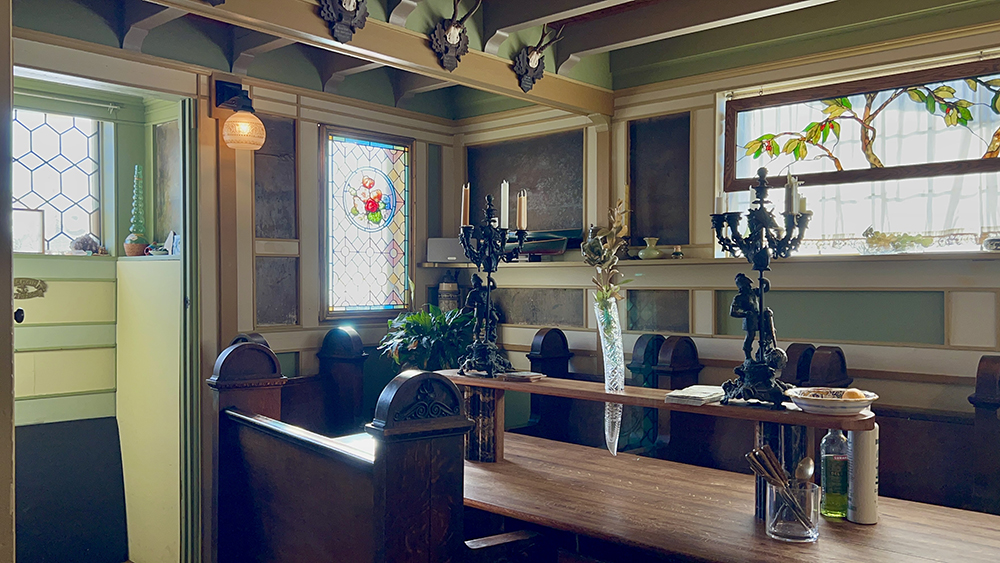
The renovation also required new flooring, since it had eroded with decades of flooding. Trying to respect the historic feel of the home, Clark acquired long wooden flooring from old, abandoned villas in Italy. He did the same for many of the personal touches he’s introduced, from a dining room table and seating created from late 19th century pews from churches that were renovated or abandoned. Such churches and other old buildings are where much of the repurposed stained-glass work that now don almost every window in the home came from, making the home Clark’s own, while still respecting Mott’s original artwork, even restoring some pieces upstairs.
One such stained-glass piece in a dining room window is the piece that sparked Clark’s career. The stained-glass window with a floral bouquet in the middle originates from an abandoned building in Vienna, where Clark spent four years of his life, after his father, who had worked on the Manhattan Project, was hired by an international atomic agency and became a diplomat in Vienna. “That was 15 years after Austria got independence and there were all these abandoned buildings, so my friends and I would crawl through them, and I found a lot of great stuff. There’s a bunch of it in the house now. But that one panel, it was beautiful, and I had it hanging in my dorm room in college and I said, ‘One day I’m gonna learn how to fix this.’”
It wasn’t until after he graduated that Clark took that goal seriously. “I took a Parks and Recreation class in it and got interested and did stained glass as a hobby,” he said. Eventually that hobby would turn into his full-time career. “I got tired of my career and quit and just started making stained glass to support myself to pay the bills. I opened my own studio in Spokane in 1983 and then came out here and closed that. But it all started with that floral panel.”
By 2006, Clark’s major renovations were complete, making the Richard Mott house livable once again, and he’s called it home ever since. But the home still contains pieces that tell its own history. Mott’s original woodwork, built-in furniture and artwork, still make up the bulk of the home. And a portrait of Mott and another man in military uniforms, and another of possible Mott family members, don the walls. Tchotchkes that he believes belonged to the Nolans can be found on shelves. A collection of old schoolbooks that George Magnifico collected, hide in shelves behind one of Mott’s paintings of birds that Clark restored. And the rest of the spaces are filled with treasures Clark has collected throughout his life and from his travels like crucifixes, replicas of ships, swords, clocks, antlers, glassware and tiffany lamps he made, but all organized and displayed in a much better manner than George Magnifico had his collected items in.
Although Magnifico never intended to sell the home, Clark feels fate made it happen, and it’s where he was meant to be. “This place definitely would have washed away during Hurricane Sandy. The water would’ve been halfway up the building and it wasn’t stable. I think the home called me here,” Clark said. “And I kind of feel like there’s a connection between me and Mott. I think somehow this occurred without me making it happen. It was serendipitous. Richard Mott probably had something to do with it. It’s really cool with me being an artist and knowing this was built by an artist and craftsman, and when I got it, I fixed everything myself, the way Richard Mott did the house himself.
“I just feel totally embraced by it and I feel like I’m connected to Mott even though I don’t know him or anything about his personality, but as a craftsman, just seeing how he made stuff and chose to do certain things and painted things, I just feel very much part of the house.”
But Clark hopes to be able to share the house with others at some point. “I’d like to turn it into a museum one day,” he said. And having the recent designation on the New York State Register of Historic Places and hopefully the National Register, is a step in the right direction. Always wanting to preserve the historic home, Clark says he was looking into getting it landmarked when the NYC Landmarks Preservation Commission referred him to the NY State Department of Parks, Recreation and Historic Preservation, which does a lot of the legwork, including extensive research into the history of a place.
“The whole idea of preserving the house in the history of Rockaway was important to me. Some of the most wonderful mansions were torn down and destroyed by bloodsucking people who wanted money, so I figured I gotta do what I can. Being on the Register is one more step to preserve and protect the house,” Clark said. “It means it’s considered a legitimate historic site and they want to see it preserved, so they have resources on what you can do to get it preserved and grant funding and tax benefits to cover the work that’s put into restoring and maintaining it.”
With the designation official as of January 2, the Richard Mott House is the first individual home on the peninsula to be on the New York State Register of Historic Places, with the potential to be on the National Register by this summer if approved. Other places on the peninsula have the designation, such as churches, firehouses and the historic bungalow district around Beach 25th and 26th Street, but Clark’s home is the first local standalone home on the New York State Register.
And for Clark, it’s an honor, and a step toward ensuring the Richard Mott House is here to stay. “It’s a compliment! But to me, it’s always been historic, that’s why I’ve been preserving it,” he said. “I love it and I love being here, I have great parties here, my nephew is even going to have part of his wedding here this year, but I do want to make it a museum one day and having this will make it easier to set up a foundation to sustain it in the future.”