Rockaway Jewish Community Hears from Holocaust Survivor
- NEWS
Rockaway Stuff
- 0
- 4 minutes read
By Bradley Finkelstein
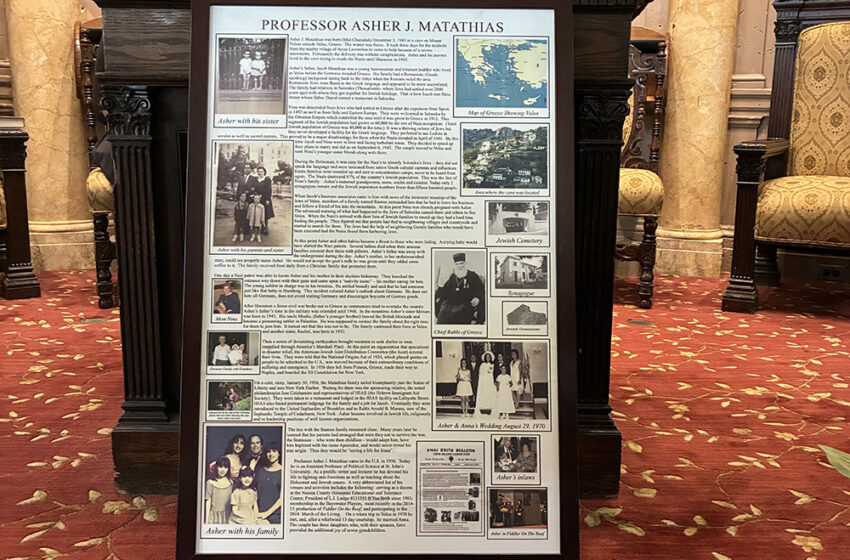
“The Nazis tried to make the Jews disappear from history and they failed,” said Professor Asher Matathias, a survivor of the Holocaust. “They failed because I am here. They failed because my wife, Anna, and I built a life. They failed because our children exist.”
He was the keynote speaker at this year’s community Holocaust Remembrance Ceremony sponsored by Temple Beth-El of Rockaway Park and the West End Temple on Sunday, April 12.
The ceremony started with the procession of candles, followed by introductory remarks by Rabbi Matt Carl of Temple Beth-El. Six children and grandchildren of Holocaust survivors then lit memorial candles and told their families’ emotional stories: Jeannette Bernstein (whose story was read by Rabbi Rebecca Epstein of the West End Temple), Jeffrey Vorsanger, Andrew Eisen, Rosalyn Brown, Sandra Finkelstein, and Warren Lakoff.
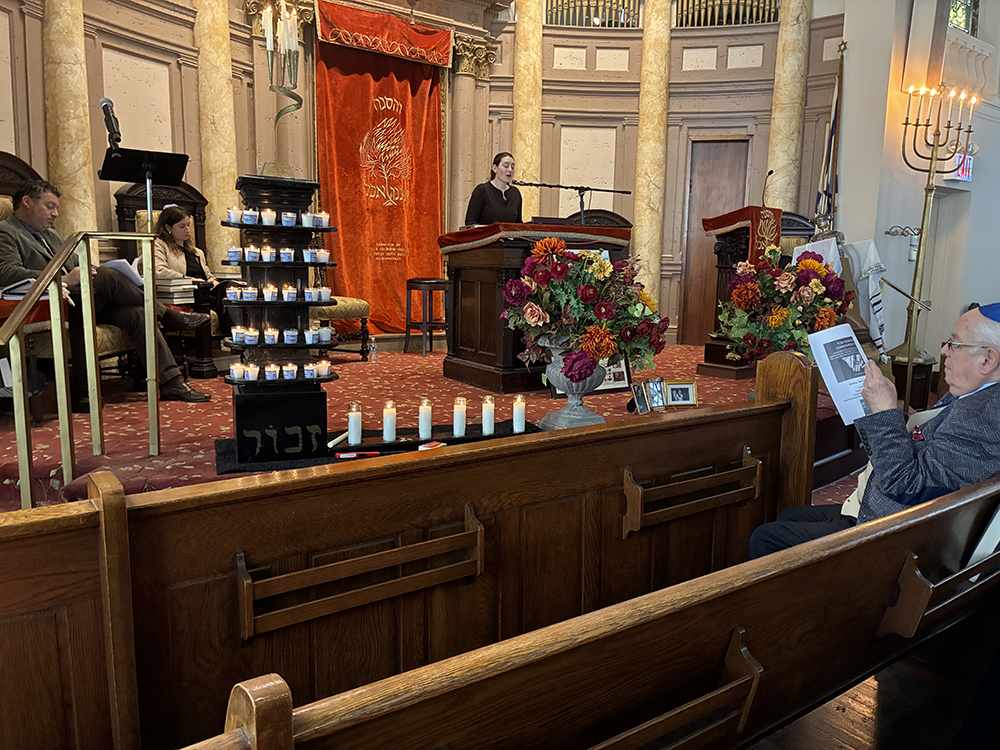
After a musical selection from West End Temple Student Cantor Margo Wagner, Professor Matathias told his story. He was born in Greece in 1943 as his family was in hiding, helped by Christian neighbors.
Before getting into his story, the professor recounted the history of antisemitism in Greece. Professor Matathias’ parents came from two different Jewish communities. His father was a Romaniote Jew from Velos, while his mother was a decedent of Sephardic Jews expelled from Spain who settled in what would become a part of Greece in 1912, Salonika, now known as Thassolaniki. It was the only majority Jewish city in Europe for nearly four centuries, the professor said.
He pointed out that 87% of the Jewish population of Greece was exterminated by the Nazis, the most aside from Poland, where 91% were killed during the Shoah.
While hiding in the forest near Velos, Professor Matathias’ family had a close encounter with a German patrol. While his father was out foraging food, the patrol came across his mother and young Asher in a makeshift crib.
“As the head of patrol passed the makeshift crib, he looked down, I must have been a beautiful baby. He smiled, smiling is always a good sign. And motioned to my mother that he left a baby like this in Hamburg. The next shout from his mouth was…out, not to bother us again.”
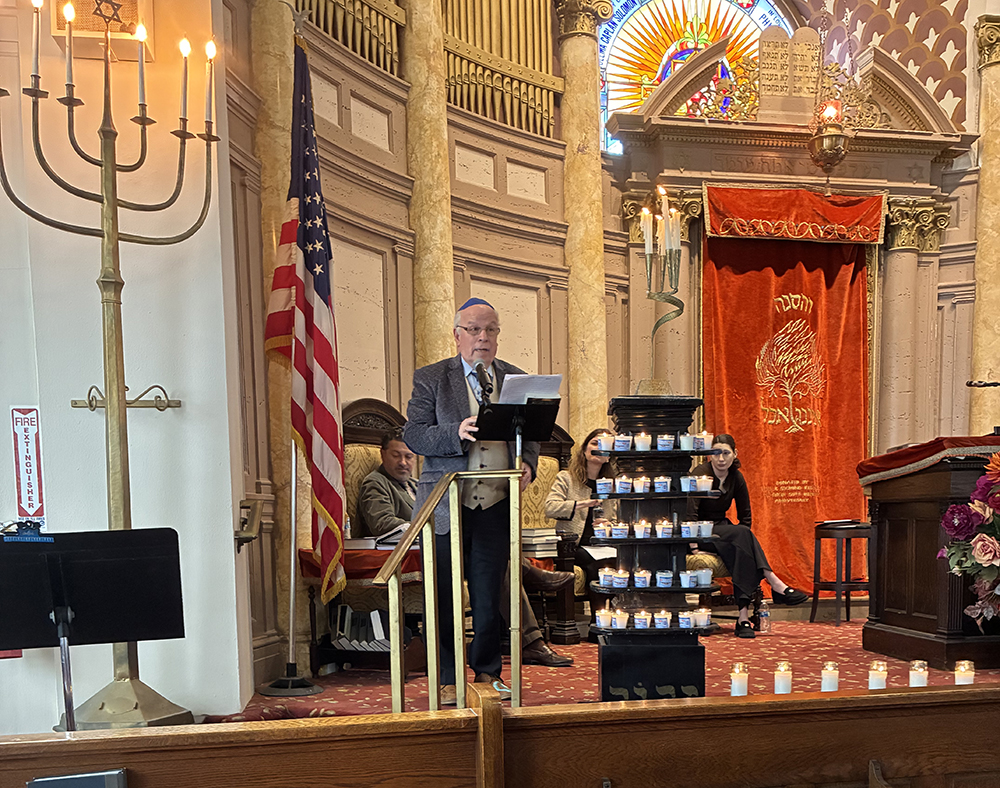
His story then took on a lighter tone for a few minutes, speaking about his family’s arrival by boat to New York, looking for the Statue of Liberty and seeing the Belt Parkway. In 1970, looking to “retrace my youthful steps.” That is when he met his wife, a Greek Jew who lived in Israel but came home to help her family.
Their wedding was such an unusual event, he said, that two newspapers in Velos came to cover it. But he soon resumed his serious nature.
“Remembering the Holocaust is not only about honoring the dead. It is about protecting the living,” he said in concluding his presentation, becoming emotional.
“It is about refusing to let hatred become normal. It is about insisting that human beings are human beings. And it is also about hope, not naive hope, not fantasy, but moral hope, hope that humanity can find itself again. I’m not asking you to believe the world is always good. I’m asking you to believe that you can be and if enough people choose that, the world changes.
“Remember that even after the greatest darkness, a spark of life can remain. I am that spark, and so are you,” Professor Matathias said.