Grave Doings in Salem: RTC’s ‘The Crucible’
- NEWS
Rockaway Stuff
- 0
- 6 minutes read
By Dan Guarino
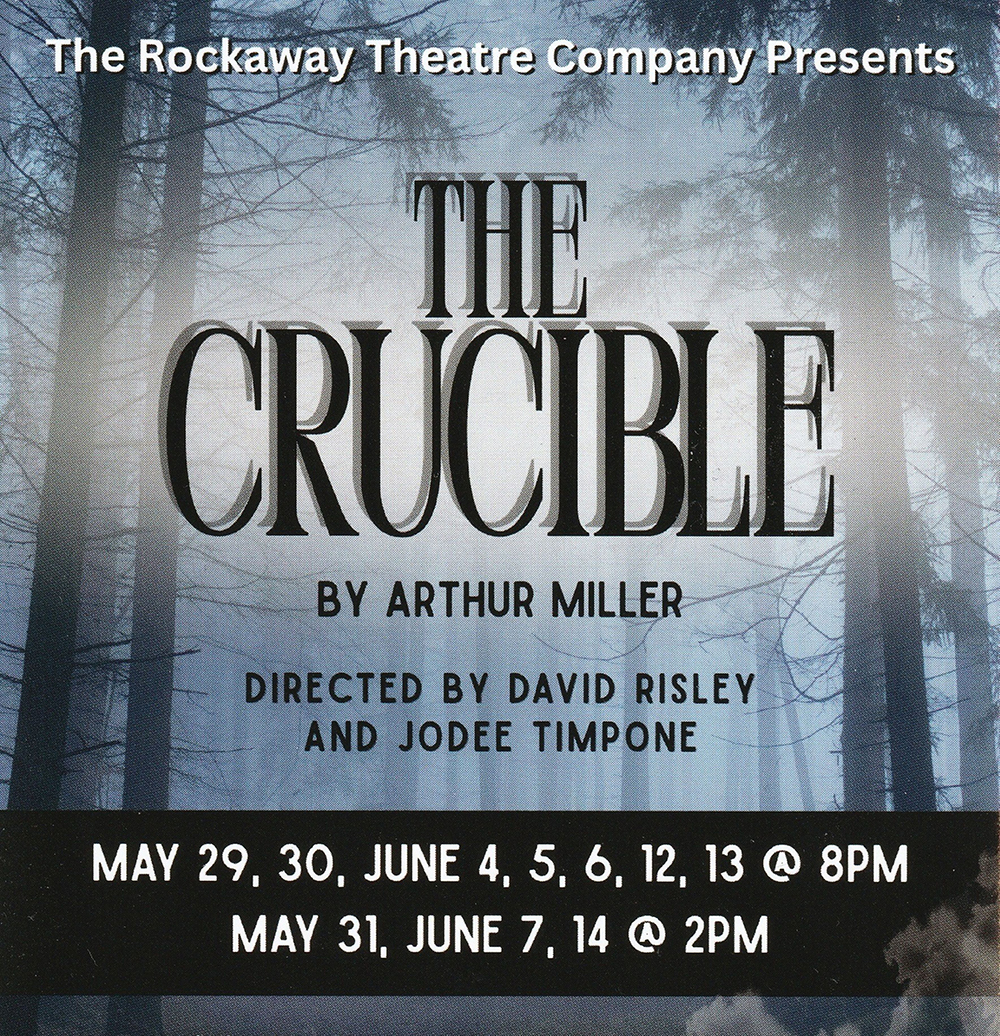
“Did you ever realize the destruction one lie can cause?” So reads the descriptive tagline for the Rockaway Theatre Company’s production of Arthur Miller’s “The Crucible.” The drama opens on Friday, May 29, at RTC’s John Gilleece Theater at Fort Tilden, and runs for ten performances through Sunday, June 14.
Tickets are available at www.rockawaytheatrecompany.org. Showtimes are Fridays and Saturdays, May 29/30, June 5/6 and 12/13, plus Thursday, June 4 at 8 p.m. and Sundays May 31, June 7 and 14 at 2 p.m.
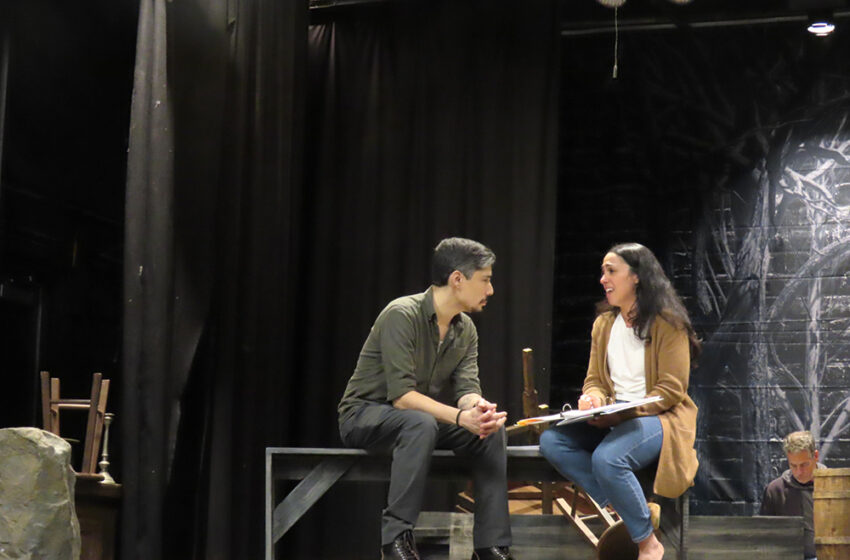
Now deep in rehearsals, this production is directed by RTC veterans David Risley and Jodee Timpone, who have previously directed “A Few Good Men,” “The Miracle Worker,” and others. Both are also accomplished actors.
“We were drawn to ‘The Crucible,’” Timpone says, “because it is based on actual events and shows how, even today, fear and accusation can take precedence over truth. It felt like an important story to revisit with a modern audience.”
Part courtroom drama and part a story of love, friendships, courage, moral choices, panic and power, those themes were very much present when famed playwright Arthur Miller wrote “The Crucible” in 1952.
He found inspiration in the late 1600’s Salem Massachusetts witch trials where, at the hysterical whim of several village girls, hundreds were accused of witchcraft. Many were hanged. Nearly all characters, albeit sometimes fictionalized for the play, were real historical people. Much revolves around the deep connection between John and Elizbeth Proctor.
Miller’s “Crucible” was a commentary on then U.S. House Un-American Activities Committee’s rampant anti-Communist hearings, where anyone could be accused on a whisper of hearsay. Many had their lives crushed, lost careers, livelihoods, and sometimes took their own lives. Or were forced to implicate others.
Risley and Timpone note, the play “explores themes like fear, power, and the consequences of false accusations. What makes it so relevant today is how easily truth can become distorted when people act out of panic or self-interest.
“In a world shaped by social media, the idea of hysteria spreading quickly feels especially familiar.”
Debuting on Broadway in 1953, “The Crucible” has won several Tony awards, and spawned several revival productions, featuring actors like Liam Neeson, Ben Whishaw, Saoirse Ronan, and Richard Armitage. George C. Scott and Colleen Dewhurst starred in a television adaption in 1968.
For the 1996 film with Daniel Day-Lewis and Wynona Ryder, Miller himself wrote the screenplay. “The Crucible” has also been adapted as an opera and a ballet.
Approaching the play with a fresh perspective, Timpone stated, “I had to read it more than once to truly get the gist. But once I had, I understood why it is considered an American classic.”
Underlining the effort and time that goes into RTC’s productions, Risley and Timpone set to work on “The Crucible” right after New Year’s Day. Though delayed by blizzards and other circumstances, intensive auditions led to rehearsals, first in Timpone’s home, then at the theater.
Since then, the entire cast has been hard at work, often rehearsing three nights a week, now going into week-long sessions as opening night approaches.
Even in early rehearsals, the actors have been delivering and sharpening powerful performances, interweaving the drama, inter-character connections and even finding occasional humor.
The cast is a mixture of talented RTC veterans and newer faces.
Timpone said, “I think anyone who chooses to audition for this play knows…that it will be challenging. The play is (often) written in a type of English that we no longer generally speak. To learn that and the proper cadence with which to deliver it alone requires dedication. Our cast has definitely risen to the occasion.
“There are 10 roles for men and 10 for women in this play. They are joined on stage by an additional group of youngsters…we have dubbed ‘The Girls’ Chorus.’
“Our younger cast members have been wonderful to work with. Once they got past the giggles caused by some of the outlandish moves we’re asking them to make, they’ve proved themselves very capable of the tasks we’ve given them.”
Everything for RTC’s “The Crucible” has been carefully considered, even down to the purpose-built stage platform, which some cast members had a hand in constructing.
The directors stated its “black box”-style staging is a new challenge for them. “Minimal everything … not a lot of set pieces, not a lot of color etc. It was difficult at times to block (arrange the actors’ movements) because some scenes required many people to be on stage at the same time. Where to put them if there were no tables or chairs….”
Timpone added, “David truly enjoys blocking so most of that falls to him. He did let me share a little of that responsibility this year. But my primary function is to pay attention to the development of the characters and how the actors deliver their lines.”
We “think the fact that there are no bells and whistles to distract the audience absolutely puts extra pressure on the actors. They have to be at the top of their game.”
Both directors agree, “We’re lucky to have creative geniuses involved at RTC.” Like Frank Caiati (who also plays John Proctor), who designed the set, in collaboration with their vision, and Tony Homsey whose team constructed it.
Diana Bayne, Jake Alessi and Rich Louis-Pierre bring the show to life through dramatic lighting and sound design. “Kathryn Squitieri and mom Fran make sure our actors look believable for the time period.” Promoting the show, “Gabrielle Mangano used her amazing creativity to come up with different ideas for social media. This year, we even enlisted the help of John Panepinto and Nicola DiPierro to throw in a little something extra. Can we say dream team?”
Risley and Timpone hope anyone coming to see this show recognizes that while “The Crucible” takes place in 1692, “the fears, divisions, and pressures within the story still feel very familiar today. We hope audiences leave not only moved by the story, but also reflecting on how relevant its questions still are in the world we live in now.”
Photo by Dan Guarino.