The Giant Anteater
- NEWS
Rockaway Stuff
- 0
- 3 minutes read

By Terri Estes
As the name implies, the giant anteater is the largest of the several anteater species. They are native to Central and South America and can reach lengths of up to eight feet long. They can also weigh upwards of 100 pounds.
The giant anteater is greyish black in appearance with a white stripe running from chest to back. Its tail is a long, bushy, feathery one, and is often used as a blanket. They have no teeth but have a super long snout with an extremely strong sense of smell which enables them to sniff out ants and termites hidden deep in wooden logs and trees. They have giant four-inch claws which allow them to rip open wood and termite mounds.
Once they have exposed these ant and termite nests, they use their long, sticky tongue to lap up thousands of these insects. Their tongue can be up to two feet long! This tongue is coated in a sticky saliva to gather food and can flick in and out at a rate of up to 150 times a minute. This allows them to consume up to 30,000 insects a day.
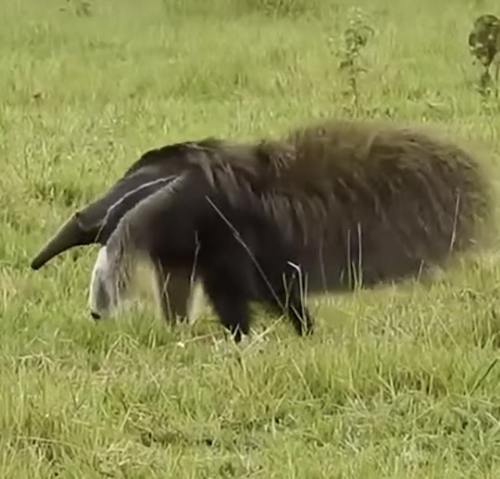
The giant anteater’s claws are so long, that they walk on their knuckles/wrists to keep them from dulling. When threatened by a predator, the giant anteater can stand on its hind legs and use their claws to deliver powerful, deadly blows to their predators. The fore claws have three main, large claws and two smaller claws. These main claws are up to four inches long, making them among the largest claws of any mammal on earth. Some report them as longer than the polar bear’s claws.
Ecologically, giant anteaters play an important role in our planet. They control the insect population in their areas. But they also use their massive claws to dig for water when there is none available, thus making watering holes for all the other animals in the area.
The bad news is, there are only about 5,000 giant anteaters left in the world. They face significant threats such as habitat loss, hunting and road kills. They are considered one of the most endangered mammals in Central America and are listed as extinct or near extinct in several areas of South America. Argentina has made a huge conservation effort to reintroduce over 100 giant anteaters back in to the wild.
Let’s hope that more countries in South America and Central America follow in the footsteps of Argentina and choose to protect this magnificent animal. Because, let’s face it, there are way too many ants in this world!